
Hiring the right employees has become more challenging than ever for startups and growing businesses. Recruiters often deal with hundreds of applications, lengthy screening processes, scheduling delays, and increasing pressure to hire top talent quickly. Traditional hiring methods are no longer efficient enough to meet modern recruitment demands.
This is where AI-powered recruitment technology is transforming the hiring industry. Businesses are now using intelligent hiring systems to automate repetitive recruitment tasks, improve candidate quality, and reduce hiring costs.
Choosing the right AI hiring platform for startups can significantly improve recruitment efficiency and help companies scale faster. However, with so many tools available in the market, selecting the right platform can feel overwhelming.
In this guide, we’ll explore the top features businesses should look for when choosing an AI recruitment solution and how modern hiring technology is helping organizations automate recruitment successfully.
Why Businesses Are Adopting AI Recruitment Tools
AI recruitment technology is no longer limited to large corporations. Today, startups and small businesses are rapidly adopting smart hiring solutions to compete for top talent.
An affordable AI recruitment software helps businesses streamline recruitment workflows while minimizing manual work. These tools use artificial intelligence, automation, and data analysis to improve hiring speed and decision-making.
Companies are increasingly investing in AI recruitment tools for small business operations because they help:
- Reduce time-to-hire
- Improve candidate screening accuracy
- Automate repetitive hiring tasks
- Enhance candidate experience
- Lower recruitment costs
- Increase hiring productivity
As hiring competition grows, AI-driven recruitment is becoming an essential part of modern business operations.
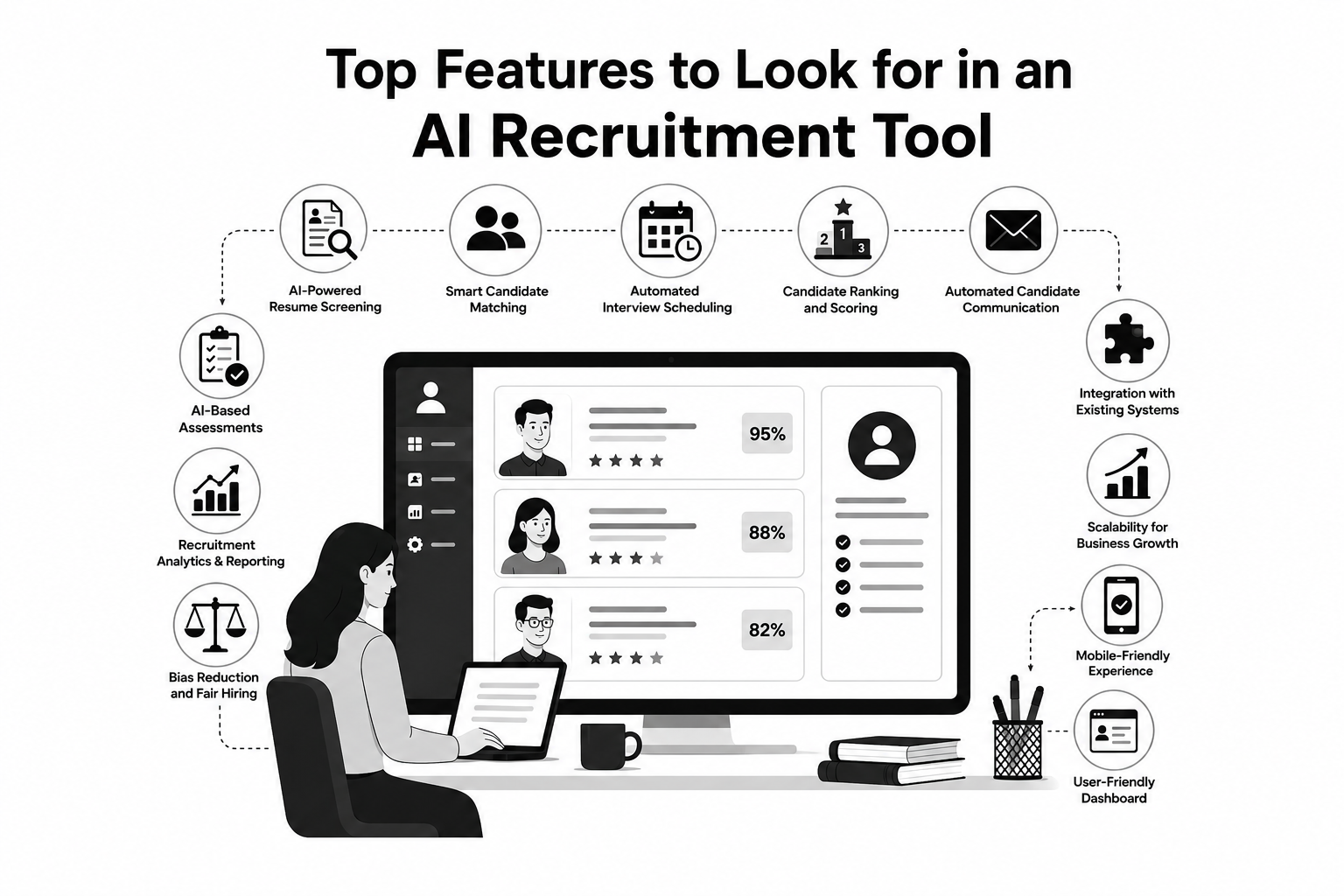
Top Features to Look for in an AI Recruitment Tool
1. AI-Powered Resume Screening
One of the most valuable features of any AI recruitment platform is automated resume screening.
Recruiters often spend hours reviewing applications manually. An AI recruitment tool can analyze resumes instantly and identify candidates that match job requirements based on skills, experience, education, and keywords.
Using an AI tool to shortlist candidates allows HR teams to focus only on qualified applicants instead of reviewing every resume individually.
Benefits include:
- Faster screening process
- Improved hiring efficiency
- Reduced manual workload
- Better candidate matching
This feature is especially useful for startups handling large application volumes with small HR teams.
2. Smart Candidate Matching
Modern AI recruitment platforms use machine learning algorithms to compare candidate profiles with job descriptions intelligently.
Instead of relying only on keyword matching, advanced platforms evaluate:
- Skills relevance
- Industry experience
- Work history
- Certifications
- Behavioral indicators
- Candidate potential
A reliable AI hiring platform for startups should help businesses discover high-quality candidates faster and improve hiring accuracy.
Smart matching also reduces the risk of poor hiring decisions.
3. Automated Interview Scheduling
Interview scheduling is one of the most time-consuming parts of recruitment.
AI-powered scheduling systems automatically coordinate interviews based on recruiter and candidate availability. This eliminates back-and-forth communication and speeds up the hiring process.
Features to look for include:
- Calendar integration
- Automated reminders
- Time-zone management
- Self-scheduling options
Businesses learning how to automate hiring with AI often begin by automating interview coordination because it saves significant administrative time.
4. Candidate Ranking and Scoring
A strong AI recruitment system should rank candidates automatically according to job fit.
AI candidate scoring helps recruiters prioritize applicants based on:
- Experience level
- Technical skills
- Job relevance
- Assessment results
- Communication quality
This feature helps HR teams identify top talent quickly while reducing bias in recruitment decisions.
For startups and growing businesses, this creates a more structured and efficient hiring workflow.
5. Automated Candidate Communication
Candidate engagement plays a major role in successful recruitment.
Many businesses lose qualified candidates because of delayed responses or poor communication during hiring.
An effective affordable AI recruitment software should include automated communication features such as:
- Application confirmation emails
- Interview reminders
- Status updates
- Rejection messages
- Follow-up communication
Automation ensures candidates stay informed throughout the recruitment process while improving employer branding.
6. AI-Based Skill Assessments
Modern recruitment platforms are moving beyond resume screening by incorporating AI-powered assessments.
These assessments help businesses evaluate:
- Technical abilities
- Problem-solving skills
- Communication capabilities
- Role-specific competencies
Using AI-based testing improves hiring accuracy and helps companies identify candidates with the right practical skills.
This feature is particularly valuable for startups hiring remote teams or specialized professionals.
7. Recruitment Analytics and Reporting
Data-driven recruitment is becoming increasingly important for business growth.
Advanced AI recruitment tools for small business operations provide hiring analytics that help recruiters make better decisions.
Important metrics include:
- Time-to-hire
- Cost-per-hire
- Source performance
- Candidate conversion rates
- Interview success rates
These insights help companies optimize hiring strategies and improve long-term recruitment performance.
8. Bias Reduction and Fair Hiring
One major advantage of AI recruitment technology is its ability to support fairer hiring practices.
AI systems can evaluate candidates based on skills and qualifications rather than subjective opinions. This helps reduce unconscious bias in hiring decisions.
While human oversight remains important, AI tools can create more consistent evaluation processes.
Businesses focused on diversity and inclusive hiring often prefer AI-driven recruitment systems for this reason.
9. Integration with Existing HR Systems
Recruitment platforms should integrate smoothly with existing business tools.
A good AI hiring solution should connect with:
- Applicant Tracking Systems (ATS)
- HR management software
- Email platforms
- Video interview tools
- Calendar systems
Easy integration improves workflow efficiency and prevents operational disruptions.
An ideal AI hiring platform for startups should simplify recruitment instead of adding technical complexity.
10. Scalability for Business Growth
As companies grow, hiring demands increase rapidly.
Startups should choose recruitment software that can scale with future hiring needs. A flexible platform allows businesses to manage:
- Higher application volumes
- Multiple hiring campaigns
- Remote recruitment
- Team collaboration
- Multi-location hiring
Scalable recruitment tools ensure businesses do not outgrow their hiring systems too quickly.
11. Mobile-Friendly Recruitment Experience
Today’s candidates frequently apply for jobs using mobile devices.
Modern AI recruitment platforms should provide:
- Mobile-friendly career pages
- Easy application forms
- Mobile interview scheduling
- Candidate communication support
A seamless mobile experience improves candidate engagement and increases application completion rates.
12. User-Friendly Dashboard and Interface
Complex recruitment systems can slow down HR teams instead of helping them.
Businesses should look for platforms with:
- Clean dashboard design
- Simple navigation
- Easy workflow management
- Clear reporting features
User-friendly platforms improve recruiter productivity and reduce onboarding time.
This is especially important for startups with smaller HR teams and limited technical resources.
How AI Recruitment Is Shaping the Future of Hiring
Artificial intelligence is rapidly transforming recruitment into a faster, smarter, and more data-driven process.
Businesses exploring how to automate hiring with AI are now leveraging technologies like:
- Predictive hiring analytics
- AI chatbots
- Intelligent candidate sourcing
- Automated assessments
- Video interview analysis
Companies that adopt AI recruitment technology early gain a strong competitive advantage in attracting and retaining top talent.
Final Thoughts
Recruitment is one of the most important growth functions for startups and small businesses. Manual hiring processes are often slow, expensive, and difficult to scale effectively.
Choosing the right AI hiring platform for startups can help businesses streamline recruitment, improve hiring quality, and save valuable time.
Whether you are searching for an affordable AI recruitment software, exploring AI recruitment tools for small business, looking for an AI tool to shortlist candidates, or learning how to automate hiring with AI, selecting the right features is essential for long-term recruitment success.
As AI technology continues to evolve, businesses that invest in smart recruitment automation today will build stronger, more efficient teams for the future.