
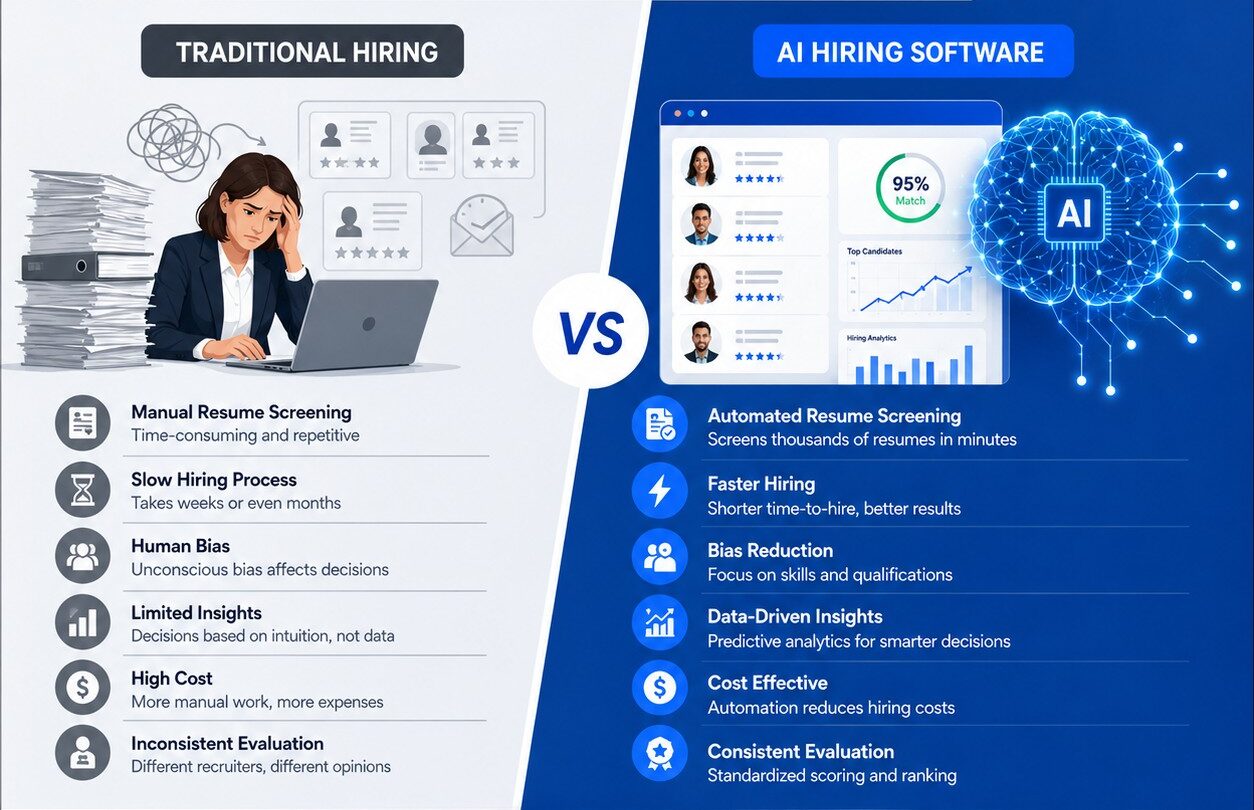
The recruitment industry is changing faster than ever before. Companies are no longer relying only on manual hiring methods, spreadsheets, and endless interview rounds to find the right talent. Instead, businesses are adopting modern technologies like AI hiring software and AI recruitment software to streamline the hiring process, reduce costs, and improve candidate quality.
Traditional hiring methods worked effectively for decades, but today’s competitive business environment demands speed, precision, and data-driven decision-making. Hiring managers often struggle with hundreds or even thousands of applications for a single job opening. Reviewing resumes manually not only consumes valuable time but also increases the chances of missing highly qualified candidates.
This is where an AI hiring platform changes the game.
Artificial intelligence is transforming how organizations attract, screen, evaluate, and hire talent. From automated resume screening to predictive analytics and candidate matching, AI-powered recruitment tools are helping companies build stronger teams faster than ever before.
In this blog, we will explore the major differences between AI hiring software and traditional hiring methods, along with their advantages, challenges, and future impact on recruitment.
What is Traditional Hiring?
Traditional hiring refers to the conventional recruitment process where human recruiters manually handle every stage of hiring. This process generally includes:
- Posting job advertisements
- Collecting resumes
- Manual resume screening
- Phone interviews
- Scheduling interviews
- Candidate evaluation
- Final selection
Although this approach allows recruiters to personally interact with candidates, it also comes with several limitations such as slower hiring cycles, human bias, inconsistent evaluation, and increased operational costs.
For years, traditional hiring was the standard recruitment method across industries. However, as businesses scale and hiring demands increase, manual recruitment processes often become inefficient and difficult to manage.
What is AI Hiring Software?
AI hiring software is an advanced recruitment technology that uses artificial intelligence, machine learning, and automation to improve the hiring process.
An AI recruitment software can analyze resumes, identify qualified candidates, automate screening, rank applicants, and even predict candidate success based on data insights.
Modern AI hiring platforms are designed to help recruiters make smarter hiring decisions while reducing repetitive manual tasks.
Common features of AI hiring software include:
- Automated resume screening
- Candidate ranking
- AI-powered skill matching
- Predictive hiring analytics
- Interview scheduling automation
- Chatbots for candidate communication
- Bias reduction algorithms
- Recruitment workflow automation
Companies using AI-powered recruitment solutions can significantly reduce hiring time while improving candidate quality and recruiter productivity.
Key Differences Between AI Hiring Software and Traditional Hiring
1. Speed of Recruitment
One of the biggest differences between traditional hiring and AI recruitment software is speed.
Traditional hiring processes are often time-consuming because recruiters manually review resumes, schedule interviews, and communicate with candidates. Hiring for a single role may take several weeks or even months.
In contrast, an AI hiring platform can process thousands of resumes within minutes. AI algorithms quickly identify the most relevant candidates based on skills, experience, education, and job requirements.
Traditional Hiring:
- Slow resume screening
- Manual candidate evaluation
- Longer hiring cycles
AI Hiring Software:
- Instant resume analysis
- Automated screening
- Faster candidate shortlisting
Companies using AI hiring software can reduce time-to-hire significantly, allowing them to secure top talent before competitors do.
2. Candidate Screening Accuracy
Manual recruitment often depends heavily on human judgment, which can sometimes lead to inconsistent candidate evaluation.
Recruiters may unintentionally overlook qualified applicants due to fatigue, workload, or unconscious bias.
An AI recruitment software uses data-driven algorithms to evaluate candidates consistently and objectively. It compares resumes against job descriptions and identifies the best matches based on predefined criteria.
This improves the accuracy of candidate screening while ensuring better alignment between job roles and applicant qualifications.
3. Reduction of Human Bias
Human bias is one of the biggest challenges in traditional recruitment.
Factors such as age, gender, ethnicity, educational background, or personal assumptions may unintentionally influence hiring decisions.
A properly designed AI hiring platform helps minimize bias by focusing on skills, qualifications, and experience rather than personal characteristics.
AI-based recruitment systems promote fairer hiring practices and support diversity in the workplace.
However, it is important to note that AI systems must also be trained using unbiased data to ensure ethical hiring outcomes.
4. Cost Efficiency
Traditional hiring can become expensive due to:
- Manual labor costs
- Recruitment agency fees
- Advertising expenses
- Administrative overhead
Recruiters spend countless hours reviewing applications and coordinating interviews.
On the other hand, AI hiring software automates repetitive recruitment tasks, reducing operational costs and improving efficiency.
Businesses can hire more effectively with smaller recruitment teams while maintaining high-quality hiring standards.
5. Data-Driven Decision Making
Traditional recruitment often relies on intuition and subjective judgment.
AI recruitment software introduces data-driven hiring strategies by analyzing candidate data, performance patterns, and hiring trends.
An AI hiring platform can provide insights such as:
- Candidate success probability
- Skill gap analysis
- Recruitment performance metrics
- Hiring funnel optimization
- Employee retention predictions
These insights help companies make smarter and more strategic hiring decisions.
6. Candidate Experience
Candidate experience plays a major role in employer branding.
Traditional hiring processes often involve delayed responses, inconsistent communication, and lengthy waiting periods.
AI-powered recruitment tools improve candidate engagement through:
- Instant communication
- Automated interview scheduling
- Chatbot support
- Real-time application updates
A smooth recruitment experience increases candidate satisfaction and strengthens the company’s professional image.
7. Scalability
Traditional hiring becomes difficult when organizations need to hire at scale.
Recruiters can only process a limited number of applications manually, which creates bottlenecks during mass hiring campaigns.
An AI recruitment software easily scales recruitment operations by handling large volumes of applications simultaneously.
This makes AI-based recruitment ideal for:
- Enterprise hiring
- Seasonal recruitment
- Startup expansion
- High-growth companies
8. Quality of Hire
Finding the right candidate is not just about filling positions quickly.
Traditional hiring methods sometimes fail to accurately predict long-term employee performance.
AI hiring software uses predictive analytics and behavioral analysis to identify candidates with higher success potential.
This improves:
- Employee retention
- Team performance
- Workplace productivity
- Cultural fit alignment
As a result, organizations achieve better long-term hiring outcomes.
Traditional Hiring Challenges
Despite its widespread use, traditional hiring faces several challenges:
High Time Consumption
Manual recruitment requires significant time for screening and coordination.
Inconsistent Evaluation
Different recruiters may evaluate candidates differently.
Limited Data Insights
Traditional methods lack advanced analytics and predictive capabilities.
Recruiter Burnout
Handling repetitive tasks increases recruiter workload and fatigue.
Difficulty Managing High Application Volumes
Large-scale recruitment becomes difficult without automation.
These limitations are driving businesses toward AI-powered hiring solutions.
Benefits of AI Hiring Software
Businesses adopting AI hiring software experience several advantages.
Faster Recruitment Process
AI reduces hiring time dramatically.
Better Talent Matching
AI algorithms identify candidates with the highest compatibility.
Improved Productivity
Recruiters can focus on strategic tasks instead of manual screening.
Enhanced Diversity Hiring
AI helps reduce unconscious bias.
Real-Time Analytics
Organizations gain actionable recruitment insights.
Cost Savings
Automation lowers recruitment expenses.
Industries Using AI Recruitment Software
AI recruitment technology is now widely used across multiple industries.
Information Technology
Tech companies use AI hiring platforms for rapid talent acquisition.
Healthcare
Hospitals and healthcare providers streamline staff recruitment using AI.
Retail
Retail businesses manage seasonal hiring efficiently with automation.
Finance
Financial organizations use AI to identify specialized professionals quickly.
Manufacturing
Manufacturers improve workforce planning through AI-driven hiring.
Is AI Replacing Human Recruiters?
A common misconception is that AI will completely replace recruiters.
In reality, AI is designed to support recruiters rather than replace them.
Human recruiters still play a critical role in:
- Relationship building
- Cultural evaluation
- Final hiring decisions
- Emotional intelligence assessment
- Leadership evaluation
AI simply handles repetitive and data-heavy tasks, allowing recruiters to focus on more strategic aspects of hiring.
The future of recruitment lies in combining human expertise with AI-powered automation.
Future of AI Hiring Platforms
The future of recruitment is strongly connected to artificial intelligence.
Modern AI hiring platforms are continuously evolving with advanced capabilities such as:
- Predictive workforce analytics
- AI video interview analysis
- Natural language processing
- Behavioral assessment
- Automated onboarding
- Skill-based hiring intelligence
As technology advances, AI recruitment software will become even more accurate, efficient, and personalized.
Businesses that adopt AI-driven hiring early will gain a significant competitive advantage in talent acquisition.
Why Businesses Should Adopt AI Hiring Software
Organizations that continue relying solely on traditional hiring may struggle to compete in today’s fast-moving talent market.
An AI hiring platform helps businesses:
- Hire faster
- Reduce recruitment costs
- Improve hiring quality
- Enhance candidate experience
- Increase recruiter efficiency
- Build stronger teams
In a highly competitive job market, companies need smarter recruitment solutions to attract and retain top talent.
Final Thoughts
The comparison between AI hiring software and traditional hiring clearly highlights the advantages of AI-powered recruitment.
While traditional hiring methods still have value in certain situations, they often struggle to keep up with modern recruitment demands.
An advanced AI recruitment software enables businesses to automate repetitive tasks, improve screening accuracy, reduce bias, and make data-driven hiring decisions.
The future of recruitment belongs to organizations that embrace intelligent hiring technologies and modernize their recruitment strategies.
If your business wants to improve hiring efficiency and attract the best candidates faster, adopting a powerful AI hiring platform is no longer optional — it is becoming essential.
To explore smarter recruitment solutions powered by artificial intelligence, visit https://www.hikara.ai