
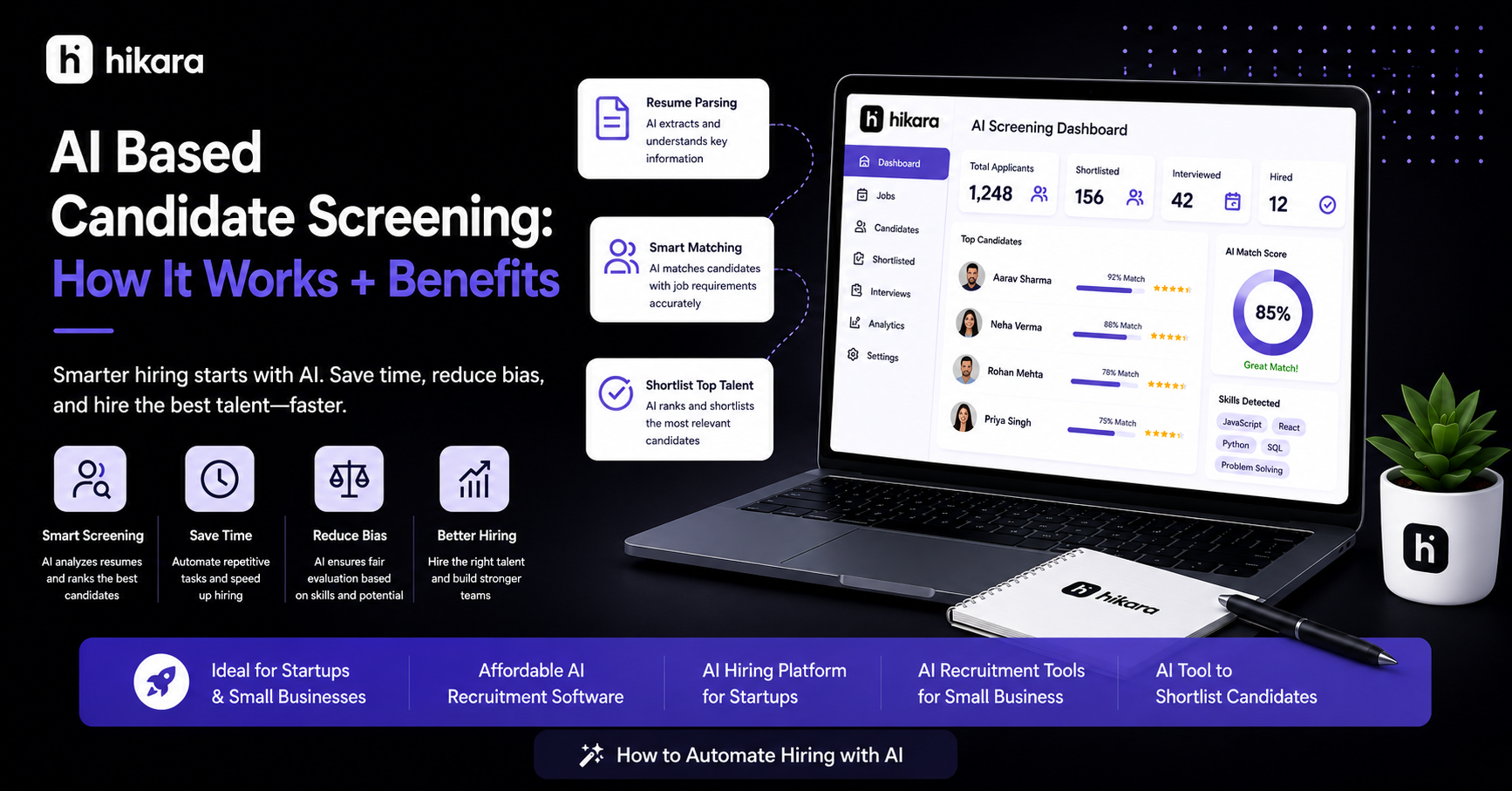
Hiring the right talent has always been one of the biggest challenges for businesses. For startups and small businesses, the pressure is even higher because every hire directly impacts growth, productivity, and company culture. Traditional recruitment methods often involve manually reviewing hundreds of resumes, scheduling interviews, and filtering candidates based on limited information. This process consumes valuable time and can lead to hiring delays, biased decisions, and missed opportunities.
This is where AI based candidate screening is transforming recruitment.
Artificial Intelligence is helping recruiters automate repetitive tasks, identify top talent faster, and improve hiring accuracy. Companies today are increasingly adopting AI hiring platforms for startups and enterprises because they simplify the recruitment process while improving candidate quality.
In this blog, we’ll explain how AI based candidate screening works, its major benefits, and why businesses are rapidly adopting affordable AI recruitment software to streamline hiring.
What is AI Based Candidate Screening?
AI based candidate screening refers to the use of Artificial Intelligence technologies to evaluate, filter, and shortlist job applicants automatically. Instead of manually reviewing resumes one by one, AI recruitment systems analyze applications using machine learning, natural language processing, and predictive analytics.
The goal is simple:
- Reduce manual hiring effort
- Improve hiring speed
- Identify the best-fit candidates
- Minimize bias in recruitment
- Enhance candidate experience
Modern AI recruitment tools for small business owners and recruiters can process thousands of resumes in minutes. These tools analyze qualifications, experience, skills, certifications, job relevance, and even behavioral patterns to determine which applicants match the job requirements.
AI screening software acts like a smart recruitment assistant that helps hiring teams make better decisions faster.
Why Traditional Candidate Screening is Inefficient
Before understanding how AI works in recruitment, it’s important to understand the limitations of traditional screening methods.
1. Manual Resume Screening Takes Too Much Time
Recruiters often spend hours reviewing resumes manually. According to industry studies, recruiters may spend only a few seconds reviewing each application. This increases the risk of missing qualified candidates.
2. Human Bias Affects Hiring Decisions
Unconscious bias can impact candidate selection. Factors like name, location, educational background, or previous companies can influence decisions even when recruiters try to stay objective.
3. High Volume Hiring is Difficult
Startups and growing companies often receive hundreds of applications for a single role. Managing this volume manually becomes extremely challenging.
4. Poor Candidate Experience
Slow response times and delayed hiring processes create a poor experience for applicants, which can damage employer branding.
5. Increased Recruitment Costs
Manual hiring requires larger HR teams, more time, and higher operational expenses.
This is why companies are increasingly searching for solutions like affordable AI recruitment software and AI tools to shortlist candidates.
How AI Based Candidate Screening Works
AI powered recruitment systems use multiple technologies to automate candidate evaluation. Let’s break down the process step by step.
1. Resume Parsing
The first step involves extracting data from resumes automatically.
AI software scans resumes and identifies information such as:
- Candidate name
- Contact details
- Skills
- Work experience
- Education
- Certifications
- Projects
- Keywords
Instead of recruiters manually reading resumes, AI converts unstructured resume data into organized candidate profiles.
This allows hiring teams to search and compare candidates easily.
2. Job Description Analysis
AI systems analyze the job description to understand:
- Required skills
- Preferred qualifications
- Experience level
- Industry knowledge
- Role-specific keywords
The software then creates a matching framework to evaluate candidates against job requirements.
For example, if a company is hiring a React Developer, the AI system may prioritize skills like:
- React.js
- JavaScript
- Frontend development
- APIs
- UI/UX experience
Candidates with higher relevance scores move to the top of the shortlist.
3. Candidate Matching
This is where AI becomes powerful.
AI algorithms compare resumes with job requirements and calculate compatibility scores. The system identifies the best candidates based on:
- Skills match
- Experience relevance
- Industry background
- Certifications
- Career progression
- Project experience
Recruiters can instantly see the most qualified applicants without reviewing every resume manually.
This is why many businesses now use AI tools to shortlist candidates faster and more accurately.
4. Keyword & Semantic Analysis
Traditional ATS systems rely heavily on exact keywords. AI recruitment software goes beyond keywords by understanding context and meaning.
For example:
- “Software Engineer” and “Developer” may be treated similarly
- “Customer Success” and “Client Support” may be recognized as related roles
Natural Language Processing (NLP) helps AI understand candidate profiles more intelligently.
This reduces the chances of rejecting strong candidates due to wording differences.
5. Automated Screening Questions
Many AI hiring platforms for startups include pre-screening questionnaires.
Candidates may answer questions related to:
- Experience level
- Salary expectations
- Availability
- Technical skills
- Work authorization
The AI system automatically filters candidates based on predefined criteria.
This saves recruiters significant time during the early stages of hiring.
6. Behavioral & Predictive Analysis
Advanced AI recruitment systems analyze candidate behavior and predict job success probability.
These systems may evaluate:
- Communication style
- Response quality
- Assessment performance
- Interview behavior
- Engagement levels
Predictive analytics help companies identify candidates likely to perform well in the role.
7. Ranking & Shortlisting Candidates
Once analysis is complete, AI software ranks candidates automatically.
Recruiters receive a shortlist of the most relevant applicants based on overall match scores.
This dramatically reduces hiring time while improving recruitment quality.
Key Benefits of AI Based Candidate Screening
AI recruitment technology provides major advantages for businesses of all sizes.
1. Faster Hiring Process
One of the biggest benefits of AI screening is speed.
AI can review thousands of applications within minutes, helping recruiters move candidates through the hiring funnel quickly.
This is especially useful for:
- Startups
- Fast-growing companies
- Seasonal hiring
- Bulk recruitment
Companies using AI recruitment tools for small business operations can significantly reduce time-to-hire.
2. Improved Hiring Accuracy
AI systems analyze data more consistently than humans.
By focusing on skills, experience, and qualifications, AI helps identify candidates who genuinely fit the role.
This improves:
- Quality of hires
- Employee performance
- Retention rates
Businesses using AI tools to shortlist candidates often report better hiring outcomes.
3. Reduced Recruitment Costs
Manual hiring processes require substantial time and HR resources.
AI automation reduces:
- Administrative workload
- Screening costs
- Recruitment overhead
- Time spent on repetitive tasks
This makes affordable AI recruitment software highly valuable for startups and small businesses with limited hiring budgets.
4. Better Candidate Experience
AI recruitment systems improve communication and responsiveness.
Candidates receive:
- Faster updates
- Quick application reviews
- Automated interview scheduling
- Improved engagement
A smoother hiring process enhances employer branding and candidate satisfaction.
5. Reduced Human Bias
AI can help create more objective hiring decisions by focusing on skills and qualifications instead of personal characteristics.
While AI itself must be carefully trained to avoid bias, properly designed systems can improve fairness in recruitment.
6. Scalability for Growing Businesses
As businesses grow, hiring demand increases.
AI hiring platforms for startups allow companies to scale recruitment without significantly expanding HR teams.
Whether a business receives 50 applications or 5,000, AI systems can manage screening efficiently.
7. Data-Driven Hiring Decisions
AI recruitment software provides analytics and insights that help recruiters improve hiring strategies.
Recruiters can track:
- Candidate quality
- Source performance
- Hiring funnel metrics
- Interview success rates
- Time-to-hire
This enables smarter recruitment planning.
How Startups Benefit from AI Recruitment
Startups often face unique hiring challenges:
- Limited HR teams
- Tight budgets
- Fast hiring requirements
- High competition for talent
This is why many startups are adopting AI hiring platforms for startups to automate recruitment.
AI tools help startups:
- Hire faster
- Reduce hiring costs
- Compete for top talent
- Improve candidate screening
- Build stronger teams
Instead of spending days reviewing resumes manually, startup founders and recruiters can focus on interviewing the best candidates.
How to Automate Hiring with AI
Businesses looking to modernize recruitment often ask: how to automate hiring with AI?
Here’s a simple step-by-step approach.
Step 1: Choose the Right AI Recruitment Platform
Select software that fits your hiring needs.
Look for features like:
- Resume screening
- Candidate ranking
- Interview scheduling
- ATS integration
- AI assessments
- Recruitment analytics
Affordable AI recruitment software is now available for businesses of all sizes.
Step 2: Create Structured Job Descriptions
AI systems perform best when job requirements are clearly defined.
Include:
- Required skills
- Experience level
- Responsibilities
- Preferred qualifications
Well-structured job descriptions improve screening accuracy.
Step 3: Set Screening Criteria
Define your hiring priorities.
Examples include:
- Minimum experience
- Technical skills
- Certifications
- Language requirements
- Industry experience
AI software will automatically filter applicants based on these criteria.
Step 4: Automate Candidate Communication
Use AI chatbots and automated workflows to:
- Confirm applications
- Send updates
- Schedule interviews
- Answer FAQs
This improves efficiency and candidate experience.
Step 5: Monitor Hiring Analytics
Track recruitment performance regularly.
Analyze:
- Candidate conversion rates
- Hiring speed
- Interview outcomes
- Quality of hires
AI driven insights help optimize recruitment strategies continuously.
Common Myths About AI Recruitment
Myth 1: AI Will Replace Recruiters
AI is designed to support recruiters, not replace them.
Human judgment remains essential for:
- Interviews
- Cultural fit evaluation
- Relationship building
- Final hiring decisions
AI simply automates repetitive tasks.
Myth 2: AI Recruitment is Only for Large Companies
Today, many AI recruitment tools for small business owners are affordable and easy to implement.
Even startups with limited budgets can benefit from AI powered hiring.
Myth 3: AI Hiring is Complicated
Modern AI recruitment platforms are designed to be user-friendly.
Most systems offer intuitive dashboards and automation features that simplify recruitment workflows.
Challenges of AI Based Candidate Screening
Although AI recruitment offers many benefits, businesses should also understand its limitations.
1. AI Bias Risks
If AI systems are trained on biased historical data, they may unintentionally replicate bias.
Companies should regularly audit AI models for fairness.
2. Over-Reliance on Automation
Recruitment should not become fully automated.
Human oversight is necessary to evaluate soft skills, personality, and cultural alignment.
3. Data Privacy Concerns
AI recruitment systems handle sensitive candidate information.
Businesses must ensure compliance with data privacy regulations and maintain strong security standards.
Future of AI in Recruitment
AI recruitment technology is evolving rapidly.
Future trends may include:
- AI video interview analysis
- Voice assessment tools
- Predictive employee retention models
- Advanced behavioral analytics
- Hyper-personalized candidate engagement
As AI continues to improve, businesses will gain even more efficient and intelligent hiring solutions.
Companies adopting AI hiring platforms for startups early will likely gain a competitive advantage in talent acquisition.
Why Businesses are Adopting AI Recruitment Tools
Organizations today need faster, smarter, and more scalable hiring processes.
AI based candidate screening helps businesses:
- Save time
- Reduce hiring costs
- Improve candidate quality
- Enhance recruiter productivity
- Build better teams faster
From startups to growing enterprises, AI recruitment tools are becoming essential for modern hiring.
Businesses looking for affordable AI recruitment software now have access to powerful automation tools that were once available only to large corporations.
Final Thoughts
AI based candidate screening is transforming how businesses hire talent.
By automating resume screening, candidate matching, and shortlisting, AI helps recruiters focus on what matters most — building strong teams.
Whether you are a startup, small business, or growing company, adopting AI recruitment technology can significantly improve hiring speed, efficiency, and decision-making.
As competition for top talent increases, companies that leverage AI recruitment tools for small business growth will gain a major advantage.
If your business is exploring how to automate hiring with AI, now is the perfect time to adopt smarter recruitment solutions.
The future of hiring is faster, more intelligent, and AI powered.