
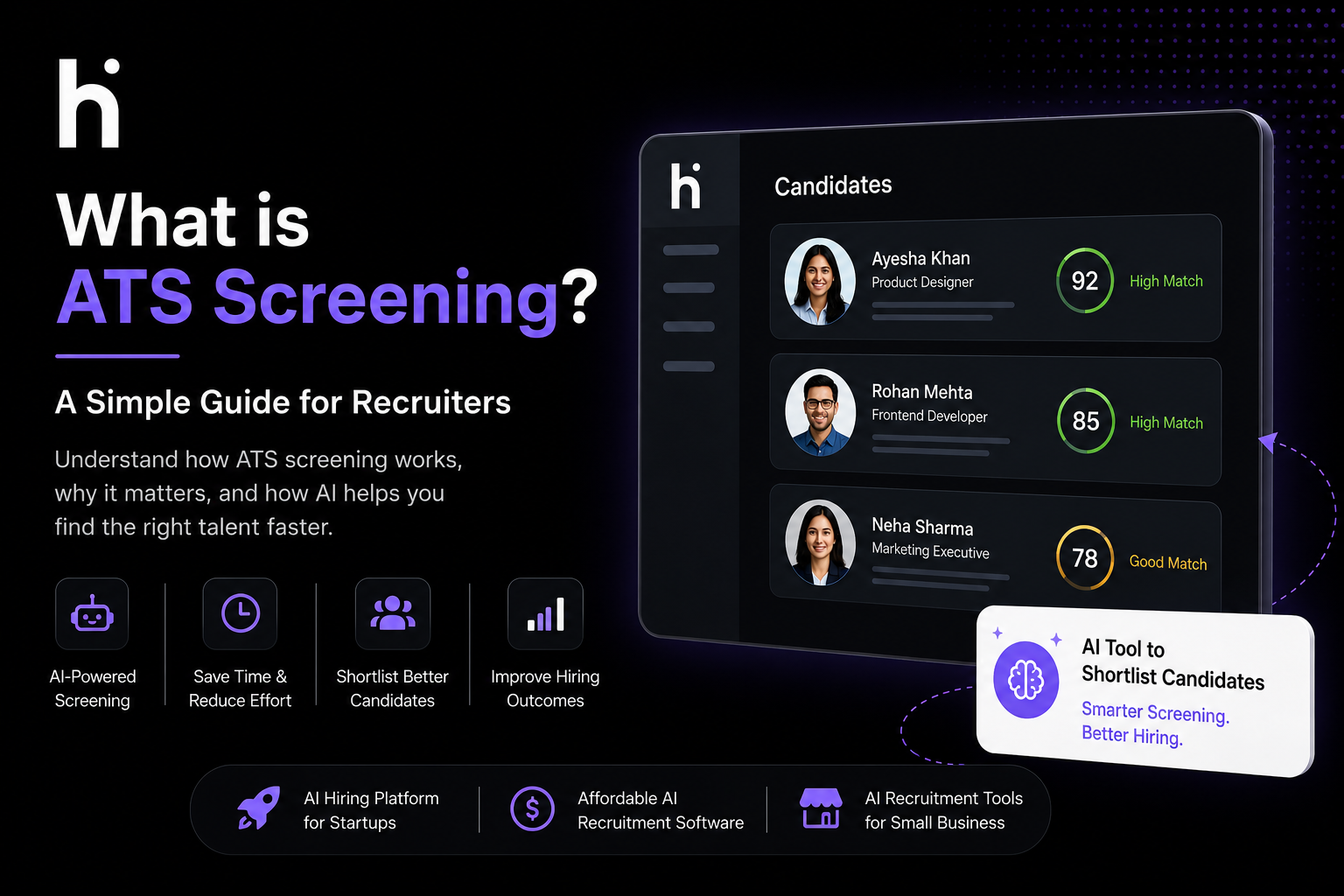
Hiring the right candidate has never been easy. Recruiters often receive hundreds of applications for a single job opening, making it difficult to manually review every resume. This is where ATS screening comes into the picture.
An Applicant Tracking System (ATS) helps recruiters organize, filter, and manage job applications efficiently. Today, modern ATS platforms are becoming even smarter with Artificial Intelligence (AI), helping startups and small businesses automate hiring processes, reduce hiring time, and improve candidate quality.
In this guide, we’ll explain what ATS screening is, how it works, why it matters, common myths, best practices, and how AI-powered hiring tools are changing recruitment.
What is ATS Screening?
ATS screening is the process where an Applicant Tracking System automatically scans, organizes, and filters resumes submitted for a job opening.
Instead of recruiters manually reviewing every application, the ATS helps identify the most relevant candidates based on job requirements such as:
- Skills
- Experience
- Education
- Certifications
- Keywords
- Job titles
- Industry relevance
The goal of ATS screening is simple: save recruiters time while improving the quality of shortlisted candidates.
Modern ATS systems are no longer just resume databases. Today’s AI-powered hiring platforms can analyze candidate profiles, rank resumes intelligently, and even predict candidate-job fit.
For growing companies, especially startups, ATS screening has become an essential part of recruitment.
Why ATS Screening Matters in Modern Recruitment
Recruitment teams are under constant pressure to hire faster while maintaining quality. Manually reviewing hundreds of resumes is time-consuming and often leads to inconsistent decisions.
ATS screening helps solve these problems by:
1. Saving Time
Recruiters can automatically filter irrelevant applications and focus only on qualified candidates.
2. Improving Hiring Efficiency
An ATS streamlines the hiring workflow from job posting to interview scheduling.
3. Reducing Human Bias
AI-based ATS systems can standardize screening processes and reduce unconscious bias.
4. Enhancing Candidate Experience
Faster response times and organized communication improve the applicant experience.
5. Supporting Scalable Hiring
For startups and growing businesses, ATS tools make it easier to manage large hiring volumes without expanding HR teams.
This is why many organizations now rely on an AI hiring platform for startups to manage recruitment more effectively.
How ATS Screening Works
Understanding how ATS screening works helps recruiters optimize hiring strategies and improve job descriptions.
Here’s a step-by-step breakdown.
Step 1: Job Posting Creation
Recruiters create a job description with required qualifications, responsibilities, skills, and keywords.
The ATS uses this information as the benchmark for candidate matching.
Step 2: Resume Collection
Candidates apply through job portals, career websites, LinkedIn, or direct applications.
The ATS stores all resumes in a centralized database.
Step 3: Resume Parsing
The system extracts information from resumes, including:
- Contact details
- Work experience
- Skills
- Education
- Certifications
- Keywords
This process is called resume parsing.
Step 4: Candidate Screening
The ATS compares candidate information against the job requirements.
Resumes are then ranked or scored based on relevance.
Step 5: Shortlisting
Recruiters review the highest-ranked candidates and move qualified applicants to the next stage.
This is where AI recruitment tools for small business become extremely useful because they automate repetitive tasks while helping recruiters focus on strategic hiring decisions.
ATS Screening vs Manual Resume Screening
Many recruiters still rely heavily on manual resume review. However, as hiring volumes increase, manual screening becomes less practical.
| Feature | ATS Screening | Manual Screening |
|---|---|---|
| Speed | Very Fast | Time-Consuming |
| Scalability | Handles Large Volumes | Difficult with High Applications |
| Consistency | Standardized Screening | Can Vary by Recruiter |
| Candidate Ranking | Automated | Manual Evaluation |
| Bias Reduction | Possible with AI | Higher Risk of Bias |
| Efficiency | High | Moderate |
Manual screening still has value, especially during final evaluations. However, combining ATS technology with human judgment creates the most effective recruitment process.
Common ATS Screening Criteria
Different ATS systems use different methods to evaluate resumes, but most focus on the following factors.
Keywords
The ATS searches for keywords that match the job description.
For example:
- Digital marketing
- Python
- Project management
- SaaS sales
- Data analysis
Skills Match
The system evaluates whether the candidate possesses required technical and soft skills.
Experience Level
Years of experience and industry relevance are important ranking factors.
Job Titles
ATS systems often prioritize candidates with similar previous job titles.
Education & Certifications
Degrees, certifications, and specialized training may improve candidate ranking.
Location & Availability
Some ATS platforms also filter candidates based on geography or work eligibility.
Advanced AI recruitment software can go beyond keywords and understand context, improving the accuracy of candidate matching.
How AI is Transforming ATS Screening
Traditional ATS platforms mainly rely on keyword matching. But modern AI-powered systems are becoming far more intelligent.
AI-driven recruitment tools can now:
- Analyze candidate-job fit
- Predict hiring success
- Identify transferable skills
- Reduce screening bias
- Rank resumes intelligently
- Automate repetitive tasks
- Improve hiring decisions using data insights
This evolution is helping recruiters hire smarter instead of just faster.
For startups and lean HR teams, using an affordable AI recruitment software solution can significantly improve recruitment outcomes while reducing operational costs.
Benefits of AI-Powered ATS Screening
Faster Candidate Shortlisting
AI systems can review thousands of resumes in minutes.
This makes it easier to quickly identify top talent.
Better Candidate Matching
AI understands context, not just keywords.
For example, it can recognize related skills and transferable experience.
Reduced Hiring Costs
Automating screening reduces administrative workload and recruitment expenses.
Improved Quality of Hire
AI-powered analysis helps recruiters identify stronger candidates more consistently.
Enhanced Recruitment Productivity
Recruiters spend less time on repetitive tasks and more time building relationships with candidates.
Data-Driven Hiring Decisions
AI tools provide analytics and insights that help optimize recruitment strategies.
This is why many companies now look for an AI tool to shortlist candidates more accurately and efficiently.
Challenges of ATS Screening
While ATS screening offers many benefits, recruiters should also understand its limitations.
Over-Reliance on Keywords
Some ATS platforms may reject qualified candidates if resumes lack exact keywords.
Resume Formatting Issues
Complex resume designs may confuse older ATS systems.
Potential Bias in Algorithms
Poorly trained AI models may unintentionally create biased outcomes.
Missing Human Context
A resume alone may not fully represent a candidate’s capabilities.
This is why recruiters should always combine ATS screening with human evaluation.
Best Practices for Recruiters Using ATS Screening
To get the best results from ATS screening, recruiters should follow these best practices.
Write Clear Job Descriptions
Use specific responsibilities, skills, and qualifications.
Avoid vague language.
Use Relevant Keywords
Include realistic keywords candidates are likely to use in their resumes.
Avoid Excessive Filtering
Overly strict filters may eliminate strong candidates.
Regularly Review ATS Settings
Update screening criteria based on changing hiring needs.
Combine AI with Human Judgment
AI should support recruiters, not replace them.
Monitor Hiring Metrics
Track metrics such as:
- Time-to-hire
- Quality of hire
- Interview conversion rate
- Candidate satisfaction
Focus on Candidate Experience
Ensure communication remains timely and personalized.
The best hiring results come from balancing automation with human interaction.
How Startups Benefit from ATS Screening
Startups often face unique hiring challenges:
- Limited HR resources
- Fast hiring needs
- High competition for talent
- Budget constraints
An AI hiring platform for startups helps overcome these challenges by automating recruitment tasks and improving efficiency.
Faster Hiring Cycles
Startups can quickly identify qualified candidates before competitors do.
Lower Recruitment Costs
Automation reduces dependency on large recruitment teams.
Better Talent Quality
AI-powered matching improves candidate selection.
Scalable Recruitment
As startups grow, ATS systems scale with hiring demands.
Improved Organization
All applications, communication, and hiring workflows remain centralized.
This is why many early-stage companies now invest in affordable AI recruitment software to support growth.
How Small Businesses Can Automate Hiring with AI
Many small businesses assume AI recruitment technology is expensive or complicated. However, modern recruitment platforms are becoming more accessible and affordable.
If you’re wondering how to automate hiring with AI, here are a few simple steps.
Step 1: Choose the Right ATS Platform
Select software designed for startups and small businesses.
Look for features such as:
- Resume parsing
- AI screening
- Candidate ranking
- Interview scheduling
- Analytics dashboard
Step 2: Create Standardized Hiring Workflows
Use consistent job descriptions and evaluation criteria.
Step 3: Automate Resume Screening
Let AI filter and rank candidates based on job fit.
Step 4: Use Automated Communication
Send interview invites, rejection emails, and status updates automatically.
Step 5: Analyze Recruitment Performance
Use hiring analytics to improve future recruitment strategies.
By implementing AI recruitment tools for small business, companies can save time, reduce costs, and hire more effectively.
Features to Look for in Modern ATS Software
Not all ATS platforms are created equal.
When evaluating recruitment software, recruiters should prioritize the following features.
AI-Based Candidate Matching
The system should intelligently rank candidates beyond simple keyword matching.
Resume Parsing
Fast and accurate resume data extraction is essential.
Automated Workflows
Automation should simplify repetitive tasks.
Integration Capabilities
The ATS should integrate with job boards, LinkedIn, email platforms, and HR tools.
Analytics & Reporting
Data insights help optimize recruitment performance.
User-Friendly Interface
Recruiters should be able to use the platform easily without technical expertise.
Affordable Pricing
Startups and small businesses need cost-effective solutions.
Choosing an affordable AI recruitment software platform can significantly improve hiring efficiency without increasing operational complexity.
Future of ATS Screening
ATS technology continues to evolve rapidly.
Future recruitment systems will likely include:
- Advanced AI candidate matching
- Predictive hiring analytics
- Automated interview assessments
- Conversational AI recruiting assistants
- Skill-based hiring models
- Bias detection algorithms
- Personalized candidate experiences
As AI becomes more sophisticated, recruiters will spend less time on administrative tasks and more time building meaningful relationships with candidates.
The future of recruitment is not about replacing recruiters — it’s about empowering them with smarter technology.
Final Thoughts
ATS screening has become an essential part of modern recruitment.
By automating resume screening and candidate management, ATS platforms help recruiters save time, improve hiring quality, and scale recruitment efficiently.
Today’s AI-powered recruitment systems go far beyond traditional keyword matching. They offer intelligent candidate ranking, predictive insights, workflow automation, and data-driven hiring support.
Whether you are a startup, growing company, or small business, investing in the right AI recruitment tools can dramatically improve your hiring process.
If you want to reduce manual workload, identify top talent faster, and improve recruitment efficiency, adopting an AI hiring platform for startups or an affordable AI recruitment software solution can be a game-changing decision.
As recruitment continues evolving, companies that embrace AI-driven hiring technology will gain a competitive advantage in attracting and hiring the best talent.
Frequently Asked Questions (FAQs)
What does ATS stand for in recruitment?
ATS stands for Applicant Tracking System. It is software used to manage and screen job applications.
How does ATS screening work?
ATS screening scans resumes, extracts information, compares candidate profiles with job requirements, and ranks applicants based on relevance.
Can ATS reject qualified candidates?
Yes, if resumes lack relevant keywords or use incompatible formatting, some ATS systems may incorrectly filter candidates.
Are AI recruitment tools useful for startups?
Yes. AI recruitment tools help startups automate hiring, reduce costs, improve candidate matching, and scale recruitment efficiently.
What is the best way to automate hiring with AI?
The best approach is to use an AI-powered ATS platform that offers resume screening, candidate ranking, workflow automation, and recruitment analytics.
Why are AI recruitment tools for small business becoming popular?
They help small businesses save time, reduce hiring costs, improve recruitment accuracy, and compete for top talent more effectively.