
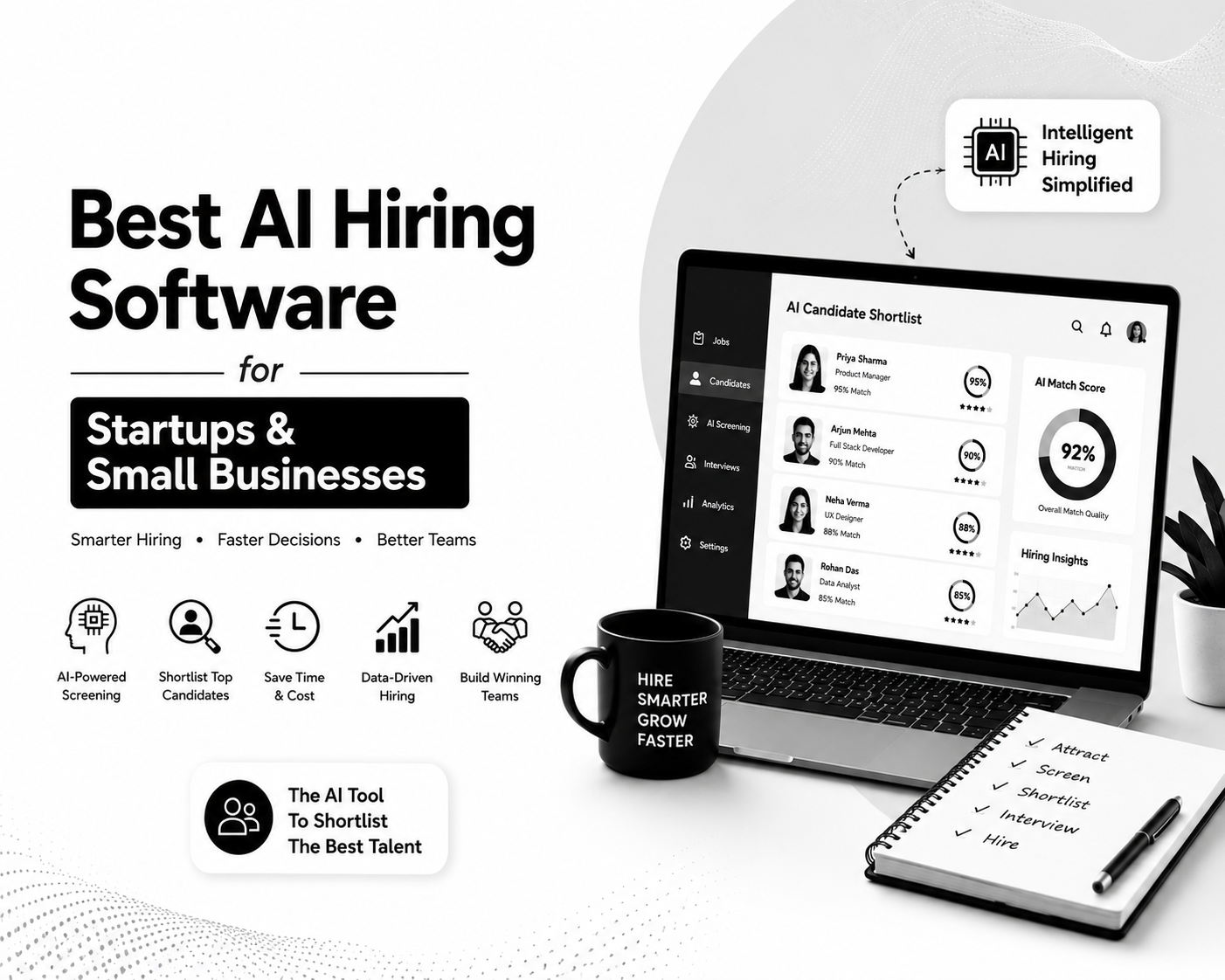
Hiring the right people is one of the biggest challenges for startups and small businesses. Unlike large enterprises with dedicated HR teams and extensive recruitment budgets, smaller organizations often need to hire quickly while managing limited resources. Reviewing hundreds of resumes, scheduling interviews, and identifying top candidates can consume valuable time that could otherwise be spent growing the business.
This is where AI-powered recruitment technology is transforming the hiring landscape. The AI hiring platform for startups has become an essential tool for businesses looking to streamline recruitment, improve hiring quality, and reduce time-to-hire.
In this guide, we’ll explore why AI hiring solutions are gaining popularity, the key features to look for, and how choosing the right affordable AI recruitment software can help startups and small businesses hire smarter.
Why Traditional Hiring Methods No Longer Work for Growing Businesses
Many startups begin their recruitment journey using spreadsheets, email chains, and manual resume screening. While this approach may work for a few hires, it quickly becomes inefficient as hiring demands increase.
Common hiring challenges include:
- Spending hours reviewing resumes manually
- Missing qualified candidates due to human oversight
- Delayed responses leading to candidate drop-offs
- Difficulty managing multiple job openings
- Inconsistent evaluation processes
- High recruitment costs
As competition for talent increases, businesses need faster and more efficient recruitment methods. This is where modern AI recruitment tools for small business provide a significant advantage.
What is AI Hiring Software?
AI hiring software uses artificial intelligence and machine learning to automate and optimize various recruitment tasks. These platforms analyze resumes, match candidates to job requirements, rank applicants, and assist recruiters throughout the hiring process.
Instead of manually reviewing every application, recruiters can use an AI tool to shortlist candidates based on skills, experience, qualifications, and job relevance.
The result is a faster, more accurate, and scalable recruitment process.
Key Benefits of AI Hiring Software for Startups
1. Faster Candidate Screening
One of the biggest advantages of AI recruitment platforms is their ability to process large volumes of applications within seconds.
Instead of spending days reviewing resumes, recruiters can instantly identify top candidates based on predefined hiring criteria.
This significantly reduces administrative workload and allows hiring managers to focus on candidate engagement.
2. Better Hiring Accuracy
Human recruiters can unintentionally overlook qualified candidates due to time constraints or unconscious bias.
AI algorithms evaluate candidates consistently by analyzing relevant data points such as:
- Skills
- Experience
- Education
- Certifications
- Job history
- Role compatibility
This leads to more informed hiring decisions and improved candidate quality.
3. Cost-Effective Recruitment
For startups, budget efficiency is critical.
An affordable AI recruitment software can reduce recruitment costs by:
- Minimizing manual screening efforts
- Lowering dependence on recruitment agencies
- Reducing time-to-fill positions
- Improving employee retention through better hiring matches
The long-term savings often outweigh the software investment.
4. Improved Candidate Experience
Candidates expect quick responses and smooth hiring experiences.
AI-powered recruitment platforms can:
- Send automated updates
- Schedule interviews automatically
- Provide instant application acknowledgments
- Maintain consistent communication
A better candidate experience strengthens employer branding and increases offer acceptance rates.
5. Scalability
As startups grow, hiring needs increase.
An AI hiring platform for startups can easily scale from hiring a few employees to managing hundreds of applications across multiple roles without requiring additional HR resources.
Essential Features to Look for in AI Hiring Software
Not all AI recruitment platforms are created equal. Before selecting a solution, startups should evaluate the following features.
AI Resume Screening
The software should automatically analyze resumes and rank candidates based on job requirements.
This enables recruiters to quickly identify the most relevant applicants.
Smart Candidate Matching
Advanced AI platforms compare candidate profiles against job descriptions and recommend the best matches.
This improves hiring accuracy and reduces screening time.
Automated Candidate Ranking
An effective AI tool to shortlist candidates should prioritize applicants using objective data rather than manual guesswork.
This ensures recruiters focus on high-potential candidates first.
Interview Scheduling Automation
Scheduling interviews often creates unnecessary delays.
AI recruitment platforms can automatically coordinate calendars and schedule interviews, reducing administrative workload.
Candidate Database Management
A centralized talent database allows recruiters to store, search, and re-engage previous applicants for future openings.
Analytics and Reporting
Recruitment insights help businesses understand:
- Time-to-hire
- Source effectiveness
- Candidate conversion rates
- Hiring bottlenecks
Data-driven hiring leads to continuous recruitment improvement.
ATS Integration
Many startups already use Applicant Tracking Systems (ATS).
The ideal AI hiring solution should integrate seamlessly with existing recruitment workflows.
How to Automate Hiring with AI
Many business owners wonder how to automate hiring with AI without losing the human touch.
The reality is that AI enhances recruiters rather than replacing them.
Here’s how the process typically works:
Step 1: Create Job Descriptions
Recruiters publish job openings through the AI recruitment platform.
Step 2: Collect Applications
Candidates apply through career pages, job boards, or referral programs.
Step 3: AI Resume Analysis
The platform automatically evaluates applications based on predefined hiring criteria.
Step 4: Candidate Shortlisting
The system identifies top-performing applicants and creates a prioritized shortlist.
This is where an effective AI tool to shortlist candidates delivers the greatest value.
Step 5: Automated Communication
Candidates receive updates, interview invitations, and reminders automatically.
Step 6: Recruiter Evaluation
Hiring managers review AI recommendations and conduct interviews with qualified candidates.
Step 7: Data-Driven Hiring Decisions
Recruiters use analytics and candidate insights to make informed hiring decisions.
The result is a faster, more efficient recruitment process with better outcomes.
Why Startups Need AI Recruitment Software More Than Large Enterprises
Large organizations often have dedicated recruiting teams and extensive hiring resources.
Startups face different challenges:
- Limited HR staff
- Tight hiring deadlines
- Budget constraints
- High competition for talent
- Rapid growth requirements
An AI hiring platform for startups helps level the playing field by providing enterprise-grade recruitment capabilities without requiring a large HR department.
Small businesses can compete for top talent while maintaining operational efficiency.
Common Myths About AI Hiring Software
Myth 1: AI Replaces Recruiters
AI automates repetitive tasks but does not replace human decision-making.
Recruiters remain responsible for relationship building, interviewing, and final hiring decisions.
Myth 2: AI Hiring Tools Are Expensive
Modern affordable AI recruitment software solutions are specifically designed for startups and small businesses.
Many platforms offer flexible pricing plans suitable for growing organizations.
Myth 3: AI Creates Bias
When properly designed, AI can help reduce human bias by evaluating candidates using consistent criteria.
The key is using transparent and responsible AI models.
Myth 4: AI is Only for Large Companies
Today’s AI recruitment tools for small business are built specifically to help smaller organizations improve hiring efficiency without enterprise-level budgets.
Why Hikara.ai is a Smart Choice for Modern Recruitment
As hiring demands continue to evolve, businesses need intelligent solutions that simplify recruitment while maintaining hiring quality.
Hikara.ai is designed to help organizations:
- Automate candidate screening
- Improve hiring accuracy
- Reduce recruitment workload
- Accelerate time-to-hire
- Enhance candidate experience
- Scale recruitment efficiently
For growing companies seeking an AI hiring platform for startups, Hikara.ai provides a practical approach to modern recruitment automation.
Whether you’re hiring your first employee or expanding a rapidly growing team, AI-driven recruitment can help you make smarter hiring decisions faster.
Future of AI Recruitment
Artificial intelligence is expected to play an even greater role in recruitment over the coming years.
Emerging trends include:
- Predictive hiring analytics
- AI-powered interview assessments
- Skills-based hiring models
- Candidate engagement chatbots
- Workforce planning automation
Businesses that adopt AI recruitment technology today will be better positioned to attract and retain top talent in an increasingly competitive market.\
Read Also: How an AI Hiring Platform is Transforming Recruitment in 2026
Conclusion
The recruitment landscape is changing rapidly, and startups can no longer rely solely on manual hiring processes. The right AI hiring platform for startups can dramatically improve recruitment efficiency, hiring quality, and candidate experience while reducing costs.
By investing in affordable AI recruitment software, businesses gain access to advanced hiring capabilities that were once available only to large enterprises.
Whether you’re exploring AI recruitment tools for small business, searching for an AI tool to shortlist candidates, or learning how to automate hiring with AI, the benefits are clear: faster hiring, smarter decisions, and stronger teams.
As competition for talent continues to grow, AI-powered recruitment solutions like Hikara.ai are becoming essential tools for startups and small businesses looking to build high-performing teams and achieve sustainable growth.